mytruc

Electroreception là một bài đọc IELTS Reading mang tính học thuật cao, chủ đề sinh học mới lạ nên dễ gây bối rối. Cá nhân mình khi lần đầu làm bài đã gặp không ít khó khăn với các thuật ngữ chuyên ngành, nhưng cũng nhờ đó mà kỹ năng đọc hiểu và tư duy phân tích được cải thiện rõ rệt.
Trong bài giải đề này, mình sẽ cùng bạn:
- Luyện các dạng câu hỏi thường gặp trong IELTS Reading.
- Hướng dẫn cách xác định từ khóa – khoanh vùng thông tin – tránh bẫy paraphrase.
- Chia sẻ kinh nghiệm thực tế khi làm bài và cách tối ưu thời gian.
- Tổng hợp từ vựng và collocations quan trọng giúp bạn nâng band Reading.
👉 Cùng mình chinh phục bài đọc này ngay thôi!
Nội dung chính
Electroreception
A
Open your eyes in sea water and it is difficult to see much more than a murky, bleary green colour. Sounds, too, are garbled and difficult to comprehend. Without specialised equipment humans would be lost in these deep sea habitats, so how do fish make it seem so easy? Much of this is due to a biological phenomenon known as electroreception – the ability to perceive and act upon electrical stimuli as part of the overall senses. This ability is only found in aquatic or amphibious species because water is an efficient conductor of electricity.
B
Electroreception comes in two variants. While all animals (including humans) generate electric signals, because they are emitted by the nervous system, some animals have the ability – known as passive electroreception – to receive and decode electric signals generated by other animals in order to sense their location.
C
Other creatures can go further still, however. Animals with active electroreception possess bodily organs that generate special electric signals on cue. These can be used for mating signals and territorial displays as well as locating objects in the water. Active electroreceptors can differentiate between the various resistances that their electrical currents encounter. This can help them identify whether another creature is prey, predator or something that is best left alone. Active electroreception has a range of about one body length – usually just enough to give its host time to get out of the way or go in for the kill.
D
One fascinating use of active electroreception – known as the Jamming Avoidance Response mechanism – has been observed between members of some species known as the weakly electric fish. When two such electric fish meet in the ocean using the same frequency, each fish will then shift the frequency of its discharge so that they are transmitting on different frequencies. Doing so prevents their electroreception faculties from becoming jammed. Long before citizens’ band radio users first had to yell “Get off my frequency!” at hapless novices cluttering the air waves, at least one species had found a way to peacefully and quickly resolve this type of dispute.
E
Electroreception can also play an important role in animal defences. Rays are one such example. Young ray embryos develop inside egg cases that are attached to the sea bed. The embryos keep their tails in constant motion so as to pump water and allow them to breathe through the egg’s casing. If the embryo’s electroreceptors detect the presence of a predatory fish in the vicinity, however, the embryo stops moving (and in so doing ceases transmitting electric currents) until the fish has moved on. Because marine life of various types is often travelling past, the embryo has evolved only to react to signals that are characteristic of the respiratory movements of potential predators such as sharks.
F
Many people fear swimming in the ocean because of sharks. In some respects, this concern is well grounded – humans are poorly equipped when it comes to electroreceptive defence mechanisms. Sharks, meanwhile, hunt with extraordinary precision. They initially lock onto their prey through a keen sense of smell (two thirds of a shark’s brain is devoted entirely to its olfactory organs). As the shark reaches proximity to its prey, it tunes into electric signals that ensure a precise strike on its target; this sense is so strong that the shark even attacks blind by letting its eyes recede for protection.
G
Normally, when humans are attacked it is purely by accident. Since sharks cannot detect from electroreception whether or not something will satisfy their tastes, they tend to “try before they buy”, taking one or two bites and then assessing the results (our sinewy muscle does not compare well with plumper, softer prey such as seals). Repeat attacks are highly likely once a human is bleeding, however; the force of the electric field is heightened by salt in the blood which creates the perfect setting for a feeding frenzy. In areas where shark attacks on humans are likely to occur, scientists are exploring ways to create artificial electroreceptors that would disorient the sharks and repel them from swimming beaches.
H
There is much that we do not yet know concerning how electroreception functions. Although researchers have documented how electroreception alters hunting, defence and communication systems through observation, the exact neurological processes that encode and decode this information are unclear. Scientists are also exploring the role electroreception plays in navigation. Some have proposed that salt water and magnetic fields from the Earth’s core may interact to form electrical currents that sharks use for migratory purposes.
Questions 1-6
Reading Passage 1 has eight paragraphs, A-H.
Which paragraph contains the following information?
Write the correct letter, A-H, in boxes 1-6 on your answer sheet.
1 How electroreception can be used to help fish reproduce.
2 A possible use for electroreception that will benefit humans.
3 The term for the capacity which enables an animal to pick up but not send out electrical signals.
4 Why only creatures that live in or near water have electroreceptive abilities.
5 How electroreception might help creatures find their way over long distances.
6 A description of how some fish can avoid disrupting each other’s electric signals.
Questions 7-9
Label the diagram.
Choose NO MORE THAN TWO WORDS from the passage for each answer.
Write your answers in boxes 7-9 on your answer sheet.
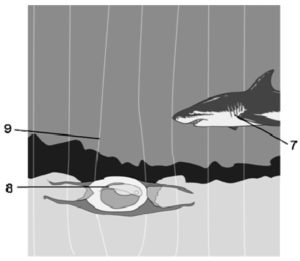
Shark’s 7 ……………….. alert the young ray to its presence.
Embryo moves its 8 ……………….. in order to breathe.
Embryo stops sending 9 ……………….. when predator close by.
Questions 10-13
Complete the summary below.
Choose NO MORE THAN THREE WORDS from the passage for each answer.
Write your answers in boxes 10-13 on your answer sheet.
Shark Attack
A shark is a very effective hunter. Firstly, it uses its 10 ……………….. to smell its target. When the shark gets close, it uses 11 ……………….. to guide it toward an accurate attack. Within the final few feet the shark rolls its eyes back into its head. Humans are not popular food sources for most sharks due to their 12 ……………….. Nevertheless, once a shark has bitten a human, a repeat attack is highly possible as salt from the blood increases the intensity of the 13 ………………..
Answer
| Đáp án | Giải thích |
| 1. C | Câu hỏi: How electroreception can be used to help fish reproduce. (Cách ứng dụng cảm biến điện để giúp cá sinh sản.) Giải thích: These can be used for mating signals and territorial displays as well as locating objects in the water. (Những cơ quan này có thể được sử dụng cho tín hiệu giao phối và thể hiện quyền lãnh thổ cũng như định vị các vật thể trong nước.) |
| 2. G | Câu hỏi: A possible use for electroreception that will benefit humans. (Một ứng dụng khả thi của cảm biến điện sẽ mang lại lợi ích cho con người.) Giải thích: In areas where shark attacks on humans are likely to occur, scientists are exploring ways to create artificial electroreceptors that would disorient the sharks and repel them from swimming beaches. (Ở những khu vực có khả năng xảy ra cá mập tấn công con người, các nhà khoa học đang tìm cách tạo ra các cơ quan phóng điện nhân tạo có thể làm mất phương hướng của cá mập và đẩy chúng ra khỏi vùng biển bơi được.) |
| 3. B | Câu hỏi: The term for the capacity which enables an animal to pick up but not send out electrical signals. (Thuật ngữ chỉ khả năng có thể bắt được tín hiệu điện nhưng không phát ra chúng của động vật.) Giải thích: some animals have the ability – known as passive electroreception – to receive and decode electric signals generated by other animals in order to sense their location. (chỉ một số loài động vật có khả năng – được gọi là khả năng cảm thụ điện thụ động – để nhận và giải mã các tín hiệu điện do các động vật khác tạo ra để cảm nhận vị trí của chúng.) |
| 4. A | Câu hỏi: Why only creatures that live in or near water have electroreceptive abilities. (Lý do chỉ những sinh vật sống gần hoặc trong nước mới có khả năng cảm nhận điện.) Giải thích: This ability is only found in aquatic or amphibious species because water is an efficient conductor of electricity. (Khả năng này chỉ có ở các loài sống dưới nước hoặc lưỡng cư vì nước là chất dẫn điện hiệu quả.) |
| 5. H | Câu hỏi: How electroreception might help creatures find their way over long distances. (Cách cảm nhận điện có thể giúp các sinh vật tìm đường trên khoảng cách xa.) Giải thích: Scientists are also exploring the role electroreception plays in navigation. Some have proposed that salt water and magnetic fields from the Earth’s core may interact to form electrical currents that sharks use for migratory purposes. (Các nhà khoa học cũng đang khám phá vai trò của cảm thụ điện trong điều hướng. Một số người cho rằng nước mặn và từ trường từ lõi Trái đất có thể tương tác để tạo thành dòng điện mà cá mập sử dụng cho mục đích di cư.) |
| 6. D | Câu hỏi: A description of how some fish can avoid disrupting each other’s electric signals. (Mô tả cách một số loài cá có thể tránh làm gián đoạn tín hiệu điện của nhau.) Giải thích: When two such electric fish meet in the ocean using the same frequency, each fish will then shift the frequency of its discharge so that they are transmitting on different frequencies. Doing so prevents their electroreception faculties from becoming jammed. (Khi hai con cá điện như vậy gặp nhau trong đại dương sử dụng cùng một tần số, thì mỗi con cá sau đó sẽ thay đổi tần số phóng điện của nó để chúng truyền đi trên các tần số khác nhau. Làm như vậy sẽ ngăn khả năng cảm thụ điện của chúng bị nhiễu.) |
| 7. respiratory movements/signals | Đoạn E: Because marine life of various types is often travelling past, the embryo has evolved only to react to signals that are characteristic of the respiratory movements of potential predators such as sharks. (Bởi vì nhiều loại sinh vật biển khác nhau thường qua lại, nên phôi chỉ tiến hóa để phản ứng với các tín hiệu đặc trưng cho chuyển động hô hấp của những loài có thể là kẻ săn mồi như cá mập.) |
| 8. tail | Đoạn E: The embryos keep their tails in constant motion so as to pump water and allow them to breathe through the egg’s casing. (Phôi giữ cho đuôi của chúng chuyển động liên tục để bơm nước và cho phép chúng thở qua vỏ trứng.) |
| 9. electric currents | Đoạn E: however, the embryo stops moving (and in so doing ceases transmitting electric currents) until the fish has moved on. (Phôi sẽ ngừng di chuyển (làm như vậy cũng ngừng truyền dòng điện) cho đến khi cá tiếp tục di chuyển.) |
| 10. olfactory organs | Đoạn E: They initially lock onto their prey through a keen sense of smell (two thirds of a shark’s brain is devoted entirely to its olfactory organs.) (Ban đầu, chúng nhắm mục tiêu vào con mồi thông qua khứu giác nhạy bén (hai phần ba bộ não của cá mập được dành hoàn toàn cho cơ quan khứu giác của nó.) |
| 11. electric signals | Đoạn F: As the shark reaches proximity to its prey, it tunes into electric signals that ensure a precise strike on its target. (Khi cá mập đến gần con mồi, nó sẽ điều chỉnh các tín hiệu điện để đảm bảo tấn công chính xác vào mục tiêu.) |
| 12. sinewy muscle | Đoạn G: our sinewy muscle does not compare well with plumper, softer prey such as seals. (cơ gân cốt của chúng ta không thể sánh bằng những con mồi to tròn, mềm mại hơn như hải cẩu.) |
| 13. electric field | Đoạn G: Repeat attacks are highly likely once a human is bleeding, however; the force of the electric field is heightened by salt in the blood which creates the perfect setting for a feeding frenzy. (Tuy nhiên, các cuộc tấn công lặp lại rất có thể xảy ra khi con người bị chảy máu; lực của điện trường mạnh lên bởi muối trong máu, tạo ra khung cảnh hoàn hảo cho cơn thèm ăn điên cuồng.) |
Lời kết
Có thể thấy đây không chỉ là một bài luyện tập đơn thuần mà còn là cơ hội để bạn nâng cao tư duy đọc hiểu học thuật. Với kinh nghiệm thực tế khi làm bài, mình nhận ra rằng việc nắm chắc từ khóa, hiểu cách paraphrase và phân bổ thời gian hợp lý chính là “chìa khóa” để xử lý những passage khó như thế này.
Hy vọng qua phần giải chi tiết và chia sẻ kinh nghiệm, bạn không chỉ hiểu rõ đáp án mà còn rút ra được phương pháp làm bài hiệu quả cho riêng mình. Đừng quên luyện tập lại nhiều lần để biến kiến thức thành phản xạ nhé!
Chúc bạn học tốt và sớm chinh phục band điểm IELTS Reading như mong muốn!